Building a successful partnership channel is one of the most cost-effective ways to scale customer acquisition. However, the software you choose to run your program will directly dictate your profit margins, operational efficiency, and tracking accuracy. In a privacy-first web where browser controls, adblockers, and cookie regulations are active, choosing the wrong affiliate platform can lead to a 30% or higher drop in tracked conversions. When attribution drops, you lose partners, waste budgets, and damage your brand's reputation.
This comprehensive buying guide is written from the perspective of a veteran consultant and operator. Instead of listing basic interface buttons, we will analyze the technical frameworks, security protocols, routing engines, and payout integrations that differentiate entry-level tools from enterprise-grade platforms. Whether you are launching a SaaS referral loop, operating a global CPA network, or managing e-commerce ambassadors, this guide will help you identify the non-negotiable capabilities your platform needs to survive and scale.
Featured Snippet: Quick Buying Summary
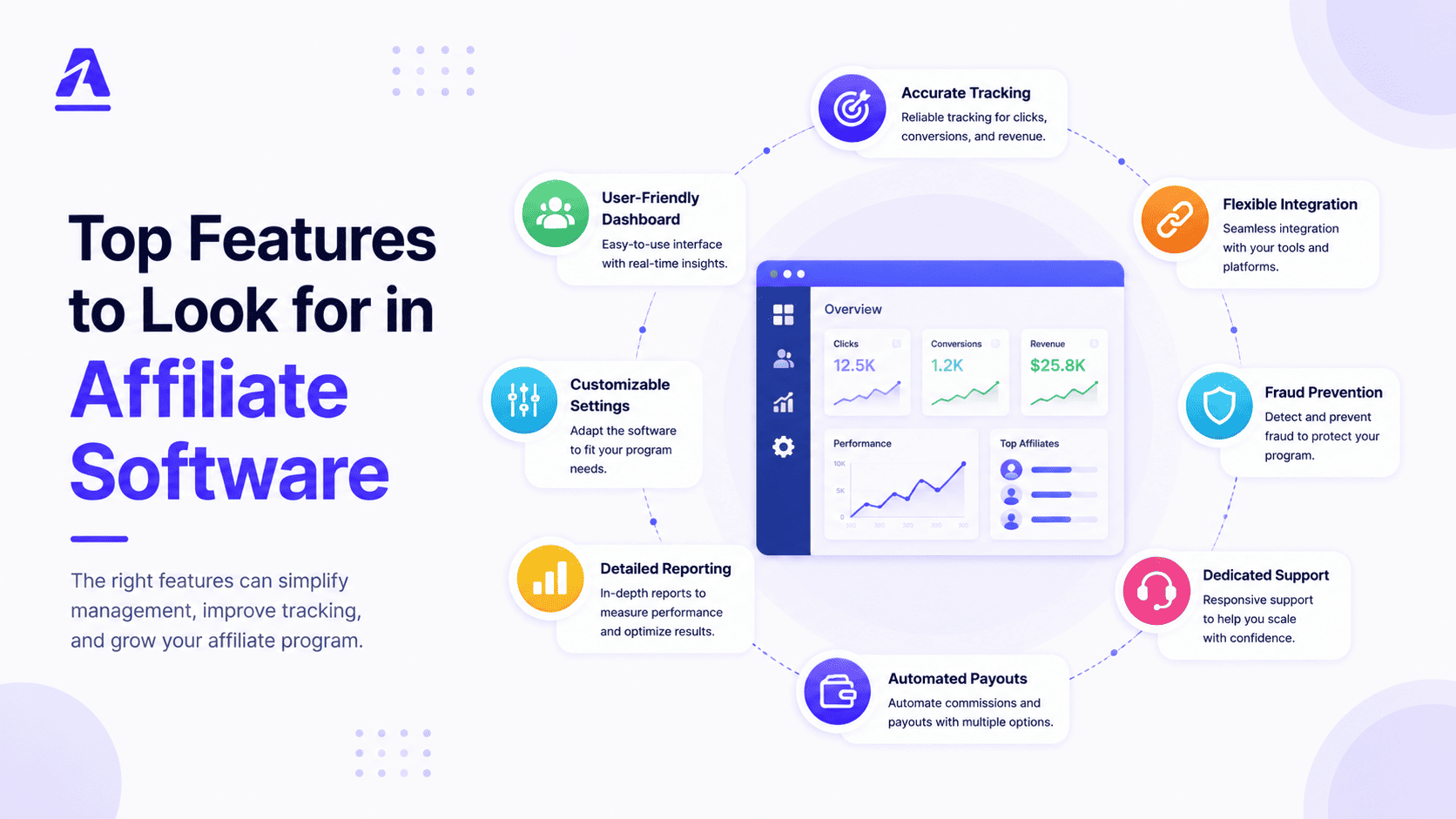
What are the top features to look for in affiliate software? The most critical features are: Cookieless Server-to-Server (S2S) tracking to bypass browser cookie limits; real-time edge fraud filtering to intercept VPN/proxy bots before conversions occur; custom CNAME subdomains to maintain first-party tracking status; multi-tier commission managers for complex payouts; and flexible REST APIs/webhooks for real-time CRM integration. Avoid software relying solely on client-side JavaScript tracking tags, which lose up to 30% of conversion signals to privacy blockades.
Why Choosing the Right Affiliate Software Matters
Your affiliate software is not just an tracking system; it is the financial ledger and operations engine of your partnership channel. When a partner sends you traffic, they are trusting your platform to accurately record their referrals and calculate their commissions. If the software suffers from redirect latency, tracking drops, or accounting bugs, that trust is shattered. Once trust is lost, your top publishers will take their valuable traffic to your competitors.
Furthermore, legacy tracking systems often charge hidden overage fees on click volume or transaction counts, penalizing your growth. Choosing a platform that combines high-speed edge tracking, transparent billing, and robust compliance tools protects your margins and guarantees that you pay only for genuine, high-quality conversion events.
How Affiliate Software Has Evolved
The affiliate marketing industry has undergone three distinct evolutionary phases:
- Phase 1: Cookie-Based Tags (2000–2015): Platforms relied on simple client-side tracking cookies and image pixels. If a browser allowed cookies, the referral tracked successfully. This model is now obsolete.
- Phase 2: Hybrid Attribution & Cloud Trackers (2015–2022): Systems introduced server-side backups, but still relied on browser storage scripts. Platforms shifted to general cloud hosting, introducing latency on redirects.
- Phase 3: Edge-First & Cookieless S2S (2022–Present): Privacy blockades (like Apple Safari ITP and browser adblockers) forced tracking to happen server-to-server. Modern platforms use custom DNS subdomains (CNAMEs) and run routing logic at edge nodes (such as Go-based microservices) to keep redirects under 15ms.
Must-Have Features Overview
When reviewing product checklists, it is easy to get distracted by flashy dashboards. However, high-performance affiliate programs are built on core technical features. Below is the detailed breakdown of the 15 critical capabilities you must look for during your software evaluation.
Feature #1: Real-Time Tracking
Attribution must happen in real-time. Delayed reporting makes it impossible for media buyers to optimize their ad spend or detect traffic anomalies. Your platform must log clicks, registrations, and sales instantly. If you have to wait for batch updates or next-day reports, you are flying blind.
Additionally, real-time logging enables automated campaign rules. For example, if a campaign reaches its conversion cap, the system must instantly route excess traffic to a fallback offer to prevent click leakage and wasted partner spend.
Feature #2: Conversion Attribution
Attribution rules determine who gets paid. Your software must support flexible attribution logic, including:
- First Click vs. Last Click: Determining whether the initial referrer or the final click before purchase receives the commission.
- Multi-Touch Attribution: Splitting commissions across multiple partners who assisted in the user's journey.
- Deterministic Attribution: Mapping conversions to a unified user ID in your database, enabling cross-device tracking when cookies are absent.
Feature #3: Postback Tracking
Server-to-Server (S2S) Postback Tracking is the industry standard for secure performance networks. Instead of firing a browser pixel, the advertiser's server fires an API webhook containing a unique cryptographic Click ID. S2S tracking is immune to browser cookie deletion, ad-blockers, and privacy policies. Ensure your software supports dynamic tokens, secure HTTPS postbacks, and includes an automatic retry queue to prevent data loss during network spikes.
Feature #4: Affiliate Management
Onboarding and managing partners at scale requires automated dashboards. Look for platforms that offer self-service affiliate portals where publishers can access their tracking links, download promotional assets, review real-time traffic statistics, and update their billing configurations. The administrative panel should let you approve or reject applicants, set custom caps, and isolate traffic sources cleanly.
Feature #5: Fraud Detection
Affiliate program budgets are constant targets for professional fraudsters. Your software must include built-in Affiliate Fraud Detection running at the edge. The system must verify geolocations, analyze canvas hardware signatures, block duplicate device setups, and cross-reference requests against active VPN and proxy databases. Look for a "Pending Clearance Queue" that holds questionable conversions for manual audit, protecting your cash flow from invalid payout liabilities.
Feature #6: Analytics and Reporting
Data drives optimization. Your platform should support deep reporting breakdowns, allowing you to drill down by publisher, campaign, geographic region, device class, operating system, and sub-ID tags. Look for interactive pivot tables, CSV export configurations, and graphical dashboards that render complex datasets in seconds.
Consultant Tip: Custom Report Speed
Many legacy systems struggle to query large click datasets, resulting in loading delays of several minutes when running monthly reports. Always test the platform's query rendering speed with high volumes of simulated click events before committing to a contract.
Feature #7: Custom Commission Management
Flexible payouts keep your partners motivated. Your software should support varied commission configurations, such as:
- Fixed CPA & CPL: Paying flat fees for leads, app installs, or registrations.
- Percentage-Based RevShare: Splitting a percentage of checkout cart values.
- Tiered & Volume-Based Commissions: Rewarding publishers with higher payout rates as they cross conversion thresholds (e.g., increasing CPA from $15 to $20 after driving 100 leads).
- Recurring Splits: Automating recurring monthly commissions for SaaS subscriptions.
Feature #8: Offer and Campaign Management
Creating and configuring campaign routes should be straightforward. Your platform must handle offer scheduling (running campaigns during specific timeframes), geo-targeting (only redirecting traffic matching target locations), device routing (sending iOS users to the App Store and Android users to Google Play), and capping limits (stopping traffic when budget limits are met).
Feature #9: White Label Capabilities
Running your platform under someone else's logo damages your brand's authority. Your chosen system should offer complete White Label Affiliate Software features. This means custom tracking subdomains (e.g., track.yourbrand.com), a branded dashboard portal matching your company's styles, and custom SMTP mail settings to route all automated partner notifications from your own email address.
Feature #10: API Integrations
An affiliate system must integrate with your existing tech stack. Look for platforms that expose a comprehensive REST API and support custom webhook bridges. This allows your development team to sync conversion logs to your CRM (like Salesforce), update billing records, or automate offer creation from external product feeds.
Feature #11: Referral Program Management
If you run a direct-to-consumer brand, enabling customer-refer-friend loops is a high-growth strategy. Your software should include Referral Program Software modules, enabling users to generate referral invite links directly from their customer dashboard and rewarding them with automated discounts, credits, or cashback incentives.
Feature #12: Partner Management
Scaling a brand requires managing varied partner classes, including editorial bloggers, social media influencers, media buyers, and loyalty networks. A robust Partner Management Software system segments these groups, allowing you to set unique tracking windows, custom coupon codes, and distinct compliance rules for each partner cohort.
Feature #13: Automated Payout Management
Processing hundreds of manual payments every month is an operational bottleneck. Look for platforms that support payment integrations (such as PayPal, Tipalti, Wise, or Razorpay), allowing you to consolidate invoices and execute batch partner payouts in multiple currencies with a single click. The system should automatically generate tax forms (W-8/W-9) and maintain clear audit trails.
Feature #14: Multi-Channel Attribution
Consumers rarely convert on their first interaction. Your software must map the entire conversion funnel, tracking touchpoints across search ads, email campaigns, organic social content, and affiliate referrals. This multi-channel view helps growth teams identify the true value of their partner traffic relative to other acquisition sources.
Feature #15: Scalability and Performance
When campaigns go viral, your tracking server must handle thousands of concurrent click requests without buckling. Choose systems engineered on high-performance frameworks (like Go or Rust) that resolve redirects at edge nodes in milliseconds. High redirect latency drops landing page conversion rates by up to 7% for every 100ms of lag.
Feature Comparison Table
To help you evaluate available options, we have compiled a comparison matrix showing how different classes of affiliate tracking software stack up across the non-negotiable architectural pillars:
| Platform Class | Tracking Method | Redirect Latency | Edge Fraud Checks | Branded CNAME | Overage Caps |
|---|---|---|---|---|---|
| Edge-First SaaS (e.g., AffTrax) | Cookieless S2S & Edge APIs | Ultra-low (<15ms) | Yes (Real-time edge) | Yes (First-party DNS) | Transparent (No penalty) |
| Enterprise Legacy (e.g., TUNE) | S2S API & Redirects | High (>80ms) | Manual filters | Yes (Paid add-on) | High overage rates |
| E-commerce Apps (e.g., Tapfiliate) | JS Pixels & Cookies | Moderate (~50ms) | No (Post-click review) | Shared domains only | Flat monthly packages |
Features Different Businesses Need
Not every business requires the same feature set. Your business model will shape your platform priorities:
Features for Affiliate Networks
Affiliate networks act as brokers managing thousands of partners across varied merchant campaigns. They require multi-tenant account isolation, customized dashboard permissions, and granular sub-ID tracking to run media arbitrage profitably.
Features for CPA Networks
CPA networks require high-speed server-to-server tracking APIs, strict geo-targeting routing, real-time edge fraud screening, and flexible commission schedules (like hybrid RevShare/CPA splits) to manage network margins efficiently.
Features for SaaS Companies
SaaS platforms operate on recurring revenue. They require deep CRM integration (matching payouts to monthly subscription renewals), automated email notifications, and self-service dashboards where business development consultants can review their pipeline.
Features for E-commerce Brands
E-commerce brands focus on direct sales. They need seamless storefront integrations (Shopify, WooCommerce), dynamic coupon tracking (crediting sales based on promo code usage without redirect links), and social media ambassador recruitment tools.
Features for Incentive Marketing Platforms
Rewards portals must synchronize points ledgers. They require high-speed API callback endpoints, instant postback routing, and VPN blocklists to verify that users are not opening duplicate accounts to exploit sign-up cashbacks.
Buying Checklist & Decision Framework
Use this decision framework and priority matrix to evaluate your options and select the right software:
| Evaluation Criteria | Target Goal / Requirement | Priority Level |
|---|---|---|
| Cookieless S2S Postbacks | Bypass browser ITP and cookie blocks | CRITICAL (Must-Have) |
| Custom CNAME Mapping | Route links via your subdomain to prevent adblock flags | CRITICAL (Must-Have) |
| Real-Time Edge Fraud Checks | Intercept proxies and bot clicks immediately | HIGH (Should-Have) |
| Batch Payment Integrations | Auto-generate invoices and run batch wire transfers | MEDIUM (Nice-to-Have) |
Common Mistakes When Choosing Affiliate Software
- Focusing on feature count over performance: Many platforms offer complex panels, but suffer from high redirect latency, causing click drop-offs.
- Relying on legacy cookie pixels: Setting up JavaScript pixels because they are "easy" will cost you up to 30% of your tracking data.
- Ignoring overage fees: Signing up for cheap base packages without calculating the overage rates billed once traffic scales.
- Using shared tracking domains: Running links on standard vendor domains. If one marketer spams, the shared domain gets blacklisted, breaking your campaigns.
Questions to Ask Before Buying
- Does the software support server-to-server (S2S) postbacks natively without third-party plugins?
- Can I run all campaign links and affiliate portals under my own CNAME subdomains?
- What is the average redirect routing latency, and do you host redirect nodes globally?
- How does the system filter out residential proxy subnets and VPN traffic?
- Is there an automatic queue to hold conversions for chargeback audits?
- Are overage fees capped, or do they scale dynamically with click volume?
Future Trends in Affiliate Technology
As browser privacy continues to tighten, client-side tracking will disappear completely. The future belongs to edge-first, server-side configurations. We are already seeing the emergence of card-linked offer databases and direct bank-integrated rewards. Platforms that route traffic via cryptographic tokenization and provide open API webhooks will dominate the digital acquisition landscape.
Frequently Asked Questions
1. What is the difference between client-side pixel tracking and server-to-server tracking?
Client-side tracking relies on the user's browser saving a cookie or executing a JavaScript pixel. Server-to-server (S2S) tracking passes a unique Click ID directly to the advertiser's server, which triggers an API webhook back to the tracker upon checkout, bypassing browser restrictions completely.
2. How does Safari's Intelligent Tracking Prevention (ITP) affect affiliate software?
Safari's ITP blocks third-party tracking cookies completely and caps the lifetime of first-party cookies set via JavaScript to 1 to 7 days, meaning standard browser tracking pixels fail to record conversions that happen after a week.
3. Why are custom CNAME tracking subdomains necessary for affiliate networks?
Custom CNAME subdomains allow you to route campaign links under your first-party DNS (e.g., track.yoursite.com). This preserves first-party cookie status and prevents ad-blockers from flagging the link as a third-party tracking script.
4. How do modern affiliate platforms prevent lead generation fraud?
Platforms prevent fraud by analyzing canvas fingerprint signatures, cross-referencing visitor geolocations, check device header configurations, and blocking proxy/VPN subnets in real-time at edge nodes before conversions occur.
5. What is the average redirect latency for standard affiliate software, and why does it matter?
Standard software redirects average 80ms to 150ms. High-performance systems keep latency under 15ms. High redirect lag drops conversion rates by up to 7% for every 100ms of delay because users abandon slow-loading hops.
6. Can I manage both affiliate and referral programs on the same platform?
Yes. Advanced partner platforms support multi-channel configurations, allowing you to run coupon-linked influencer campaigns, editorial blogger reviews, and customer referral invite loops from a single unified system.
7. What are the key payout automation features to look for in partner management software?
Look for automated billing ledger reconciliation, self-service partner invoicing, automated W-8/W-9 tax form collection, and direct integrations with batch payment gateways (like Wise, PayPal, or Razorpay).
8. How does multi-touch attribution work in affiliate tracking platforms?
Multi-touch attribution tracks every affiliate link click in a user's purchase funnel and distributes fractional commission payouts based on custom rules (e.g., sharing commissions between the first referrer and the last click).
9. Do I need an in-house developer to implement enterprise-grade affiliate tracking?
No. While server-to-server API mapping requires basic parameters, modern SaaS platforms provide step-by-step integrations, pre-made templates for CRM systems, and CNAME setups that require only basic DNS mapping.
10. What are tiered commission structures and how do they benefit networks?
Tiered structures automatically raise payout rates as publishers hit conversion milestones (e.g., increasing payout by 20% after driving 50 verified sales), motivating partners to scale their campaigns.
11. How do postback fallback redirect loops work to prevent data loss?
If an advertiser's server fires a webhook but your tracking system experiences a temporary drop, an automated queue keeps the transaction logs safe, retrying validation using exponential backoff over a 72-hour period.
12. Why are shared tracking domains risky for brand email campaigns?
If another customer of your tracking provider spams, the shared domain gets flagged by email filters. This blacklists the URL, blocking tracking links across your campaigns. Always run your programs on custom DNS domains.
13. How does card-linked reward tracking differ from standard redirect tracking?
Card-linked offers connect a consumer's credit card to your system. When they swipe their card at a store, the transaction is reported directly by the payment processor (like Visa or Plaid), bypassing redirect links completely.
14. What API endpoints are necessary for integrating affiliate systems with CRM software?
You need endpoints to query click logs, sync conversion records, register new publishers, fetch active campaigns, and pass Transaction IDs to reconcile billing splits inside Salesforce or HubSpot.
15. How do I choose between bootstrapped white-label platforms and enterprise-grade SaaS?
Choose white-label platforms if you require custom domains, fast setups, and low costs under your own branding. Choose enterprise SaaS if you need dedicated account support and pre-made integrations with corporate ERP tools.
Conclusion
Your affiliate software is the structural foundation of your partnership channel. As browser privacy protocols continue to lock down traditional tracking methods, prioritizing server-side postback tracking, CNAME domain configurations, and sub-15ms edge routing is essential to secure your acquisition campaigns. By utilizing an edge-first tracking engine like AffTrax, brands, CPA networks, and e-commerce platforms can run branded tracking interfaces, block VPN traffic instantly at the edge, and automate payouts with confidence. To protect your margins and scale your partner channel, launch your program on White Label Affiliate Software architecture today.