When designing a performance-based growth channel, founders, Marketing Directors, and growth teams often struggle to choose the best customer acquisition model. Two of the most commonly confused frameworks are Incentive Marketing and Affiliate Marketing. While both models operate under the broader umbrella of performance marketing—meaning you only pay when a desired user action is completed—they rely on fundamentally different traffic sources, user motivations, and conversion quality thresholds.
Choosing the wrong model can lead to misallocated acquisition budgets, high customer churn rates, fraud compliance headaches, and damaged relationships with your publishing partners. Conversely, setting up both models correctly can help you capture massive transaction volumes while protecting your profit margins. In this guide, we will break down the structural differences, advantages, disadvantages, and real-world applications of each model, helping you make an informed decision for your brand's growth strategy.
Quick Answer Featured Snippet
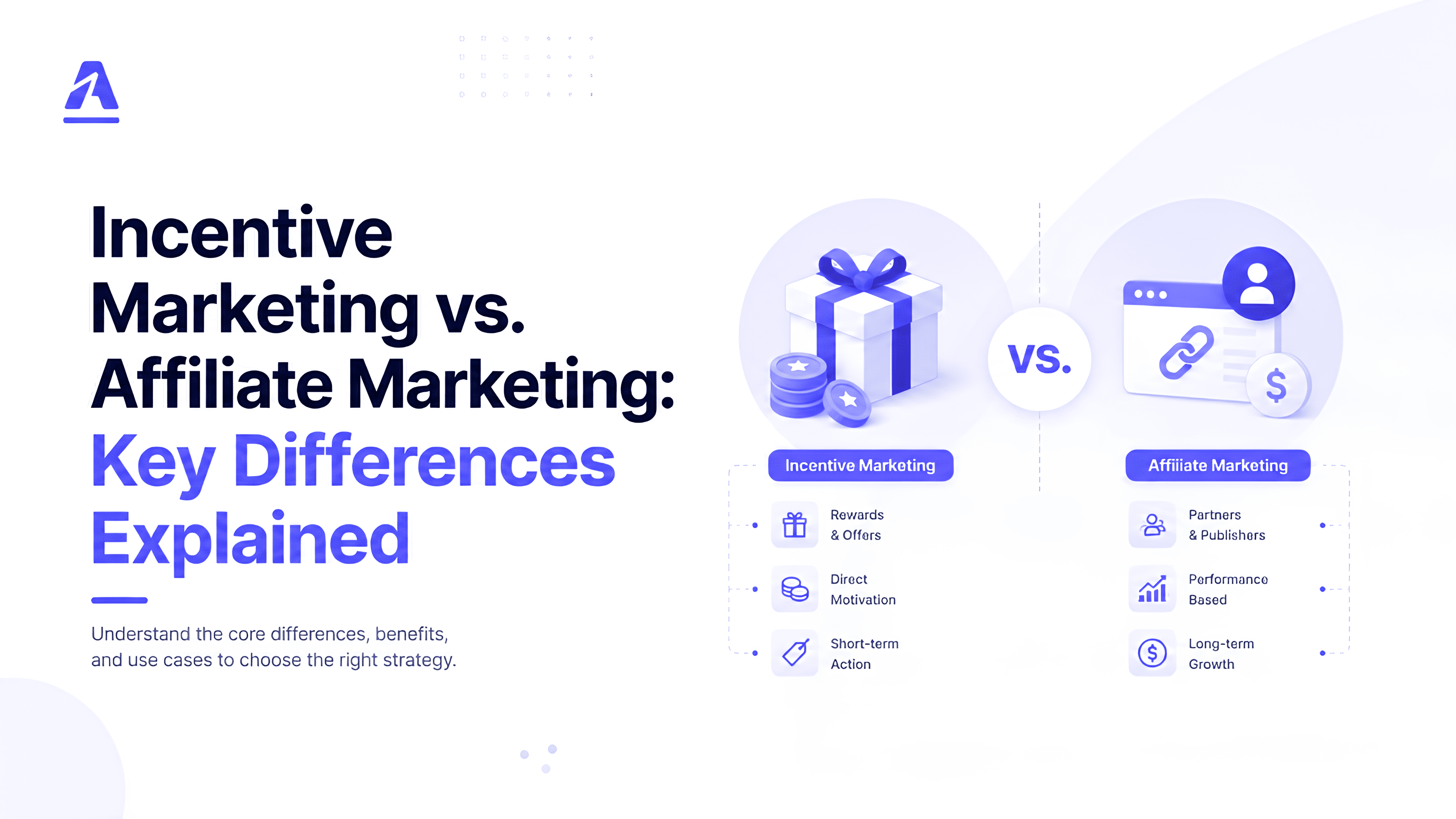
What is the difference between incentive marketing and affiliate marketing? The main difference lies in the end-user's motivation. Incentive Marketing offers the user a direct, tangible reward (such as cashback, points, or virtual tokens) to complete an action. Affiliate Marketing relies on content recommendations, product reviews, and editorial authority to guide users to a product. The affiliate publisher earns a commission, but the end-user receives no direct kickback. Consequently, affiliate marketing yields higher lifetime value (LTV) and lower fraud rates, while incentive marketing scales transaction volumes much faster at a lower cost-per-action (CPA).
What Is Incentive Marketing?
Incentive marketing (sometimes referred to as rewards marketing or loyalty marketing) is a performance-based acquisition model where the end-user is explicitly compensated to complete a specific task. The incentive functions as a direct rebate or financial hook, prompting immediate user engagement.
These rewards are typically distributed via specialized rewards platforms, loyalty program operators, or Get-Paid-To (GPT) websites. The incentive itself can take several forms:
- Cashback & Rebates: Releasing cash back on e-commerce transactions or credit applications.
- Loyalty Points: Awarding airline miles, credit card points, or merchant coins that can be redeemed for gift cards.
- Virtual Currency: Rewarding mobile game players with gold, gems, or lives for completing offers.
- Gift Cards & Vouchers: Sending electronic Amazon, Visa, or retail cards upon verification of a lead form.
From a behavioral standpoint, incentive marketing leverages extrinsic motivation. The user is not necessarily interested in the brand itself; their primary goal is to complete the transaction to obtain the reward. Because of this, it is frequently used for low-friction actions such as mobile app installations, email subscriptions, credit checks, or survey completions.
What Is Affiliate Marketing?
Affiliate marketing is a content-driven performance acquisition model where independent publishers (affiliates) promote a merchant's products or services to their audience. The publisher receives a commission only when a referral leads to a validated transaction, such as a sale, subscription, or qualified lead.
Unlike incentive marketing, the end-user receives no rebate, payout, or reward. The transaction is driven entirely by intrinsic motivation—the user has a genuine need for the product or service and trusts the affiliate's recommendation. Typical affiliate traffic sources include:
- Editorial Review Sites: Niche blogs that write comparisons, product evaluations, and tutorials.
- Coupon and Deal Platforms: Directories that curate active discounts and promo codes.
- Influencers & Content Creators: Social media personalities endorsing products in their videos or posts.
- Price Comparison Engines: Aggregators that compare software features, pricing tiers, and hardware performance.
Because the transaction is built on informational value and trust, affiliate programs are ideal for high-consideration purchases, premium SaaS platforms, e-commerce brands, and B2B services.
Why Businesses Often Confuse the Two
The confusion between incentive and affiliate marketing arises because both share a common technical parent: they operate on a pay-for-performance model. In both scenarios, the advertiser sets a target Cost-Per-Action (CPA) or Cost-Per-Lead (CPL), pays a partner network, and tracks conversions via a unique tracking link.
Additionally, the lines have blurred because modern cashback platforms and loyalty apps often join traditional affiliate programs. For example, when a user activates a Honey coupon or a Rakuten cashback widget at checkout, the transaction is technically routed through an affiliate network. However, because the consumer is receiving a direct reward (cashback or discounts), the underlying traffic dynamics behave like an incentive marketing channel. To keep campaigns profitable, growth managers must segment these partners and understand that they operate on distinct user behaviors.
Key Differences at a Glance
To evaluate these models for your business, it is essential to look at the structural trade-offs. While incentive marketing excels at driving rapid, high-volume conversions, affiliate marketing is the gold standard for long-term customer retention and high-margin LTV.
The 10-Dimensional Comparison Grid
Here is how both channels compare across the ten critical operational metrics that shape performance marketing outcomes:
| Metric | Incentive Marketing (Rewards Model) | Affiliate Marketing (Content Model) |
|---|---|---|
| Customer Acquisition | Rapid, massive volume spikes; user completes tasks for external rewards. | Steady, organic growth; driven by research and product affinity. |
| User Engagement | High immediate engagement; high drop-off and churn rates post-reward. | Slower initial engagement; high long-term retention and product usage. |
| Traffic Quality | Lower average quality; contains high percentage of casual users. | Premium quality; highly aligned with search intent and user trust. |
| Conversion Rates | Very high (often 20% to 50% on initial signup funnels). | Moderate (typically 1% to 5% depending on offer alignment). |
| Scalability | Extremely fast; can scale to thousands of conversions in hours. | Gradual; requires publisher recruitment and content indexing. |
| Cost Efficiency | Low upfront cost per action; requires strict margins to prevent leakage. | Higher cost per action; offset by high customer lifetime value (LTV). |
| Fraud Risk | Very High (VPN abuse, bots, emulator scripts, multi-accounts). | Low to Moderate (Ad hijacking, cookie stuffing, brand bidding). |
| Tracking Requirements | Real-time S2S validation, proxy checks, instant points postbacks. | Multi-touch attribution, cookieless redirects, tracking subdomains. |
| ROI Potential | Highly profitable for high-volume apps with fast monetization. | Excellent long-term ROI driven by compound organic traffic. |
| Long-Term Value (LTV) | Low (Often under 15% active user retention after 90 days). | High (High customer loyalty, low churn, repeat orders). |
How Incentive Marketing Works
Incentive marketing operates as a closed loop between the consumer, the reward platform, the tracking software, and the merchant. Here is a technical breakdown of the conversion sequence:
- The consumer logs into a Rewards Platform or GPT app and browses available offers (e.g., "Install this app and reach Level 5 to earn 500 coins").
- The user clicks the tracking link. The rewards platform generates a unique Transaction ID and appends it to the link redirection.
- The redirection routes the user through an Incentive Marketing Platform or redirect gateway, which runs security checks to verify that the click is coming from a real mobile device and not a proxy or VPN.
- The user completes the milestone (e.g., runs the app, registers an account, or makes a micro-deposit).
- The merchant's server records the event, retrieves the stored Transaction ID, and fires a server-to-server (S2S) postback webhook back to the tracking system.
- The tracking system validates the callback, registers the conversion, credits the reward network, and updates the rewards platform's points ledger to release the coins to the consumer.
Technical Note: Points Ledger Integrity
Incentive programs require absolute database synchronization. If your postback tracking is slow or drops a webhook, the user does not get their points, leading to a flood of customer support complaints. A high-performance tracking system is a non-negotiable requirement for this model.
How Affiliate Marketing Works
Affiliate marketing is built on content recommendations and organic user journeys. The technical flow relies on trust and cookie-less attribution matching:
- A consumer searches Google for a solution (e.g., "best accounting software for SaaS companies").
- The consumer lands on an affiliate's comparison website, reads an in-depth review, and decides to buy.
- The user clicks the affiliate's review link, which resolves through an Affiliate Tracking Software redirect domain (e.g.,
track.yoursite.com) to generate a cookieless Click ID. - The tracking server redirects the user to the merchant's store, passing the Click ID inside the URL query string.
- The merchant's e-commerce software or CRM platform saves the Click ID.
- When the checkout completes, the merchant's platform calls the tracker's postback API to credit the referring affiliate publisher with their commission split.
Traffic Sources Compared
The primary traffic sources for each model dictate the type of audience you will reach:
Incentive Traffic Sources
- Offerwalls & SDK integrations: Grids of tasks embedded inside mobile apps, virtual worlds, and games.
- Cashback Portals & Browser Extensions: Toolbars that alert users to rebates and coupon matches when shopping.
- GPT (Get-Paid-To) Networks: Portals where users complete surveys, watch video ads, or test products for cash rebates.
- Referral Programs: Viral invite-a-friend loops where active users invite acquaintances for shared account credits.
Affiliate Traffic Sources
- SEO Content Publishers: Websites optimized to rank for buying-intent search terms.
- Email Newsletter Creators: Industry analysts recommending selected tools to their subscriber lists.
- Social Influencers & Vloggers: Creators showcasing product tutorials on YouTube or Instagram.
- Arbitrage Media Buyers: Professional marketers running paid search or native ads directly to landing pages.
Customer Motivation: Intrinsic vs. Extrinsic
To understand conversion quality, you must look at human psychology. The type of motivation shapes the consumer's behavior after the conversion is logged:
"Incentive traffic is motivated by the reward; affiliate traffic is motivated by the product. This distinction is the single most important factor determining your post-conversion customer retention."
Extrinsically motivated users (incentive) will naturally look for the path of least resistance to claim their points. They may sign up for a fintech app, secure the rewards, and immediately delete the app. Intrinsically motivated users (affiliate) are seeking to solve a specific pain point. They buy because they want the product to streamline their business, improve their lifestyle, or save time, making them highly loyal, long-term clients.
Conversion Quality: Retention and Churn Metrics
Because customer motivation differs, retention metrics reflect a wide performance gap:
- Incentive Churn: Expect high initial drop-off. On average, 70% to 85% of users acquired via incentive channels become inactive within 30 days of receiving their reward. To make these campaigns profitable, you must structure milestones that force the user to experience the core product value (e.g., requiring them to make three bank transfers or log into a tool for five consecutive days).
- Affiliate Churn: Churn rates are significantly lower. Because these users did not receive a rebate, they are committed buyers. Affiliate-acquired users typically show 3x to 5x higher 90-day retention rates compared to incentive-acquired users.
Cost Structure Comparison
The pricing structures for these models reflect the quality of the audience:
Incentive Pricing Model
Incentive marketing is dominated by low-cost CPL or CPA actions. Because the reward reduces user friction, advertisers can secure leads for as little as $1.00 to $5.00. The cost is highly predictable, and the low CPA makes it ideal for bootstrapping initial user counts.
Affiliate Pricing Model
Affiliate commissions are significantly higher. Publishers representing high authority demand premium payouts. For SaaS platforms, this often translates to a 20% to 30% recurring lifetime commission split, or high CPA payouts ranging from $50 to $200+ per validated sale. While expensive, this cost is offset by the customer's high lifetime value (LTV).
Scalability Comparison
If you need velocity, incentive marketing is the clear winner. A single promotion placed on a high-traffic rewards platform can drive 10,000 lead submissions or app installations in less than 24 hours. This makes it an ideal strategy for product launches, brand awareness campaigns, or climbing app store algorithmic charts.
Affiliate marketing scales slowly. You cannot force content publishers to write reviews overnight, and organic search traffic takes months to index and grow. Scaling an affiliate channel requires active outreach, partner recruitment, and continuous support, but the resulting traffic represents a sustainable, long-term asset.
Tracking and Attribution Comparison
Both models require modern tracking software, but their configuration demands are distinct. Affiliate campaigns require tracking subdomains (e.g., partners.brand.com) to run cookieless S2S attribution across different device classes and browsers. The attribution must account for multi-touch paths (e.g., did the user click a blog review first, and then a coupon site?).
Incentive tracking is focused on real-time webhook delivery and database security. When a user completes a task, the validation engine must verify the completion and notify the rewards platform's points ledger instantly. Any lag in tracking results in immediate user complaints and damaged publisher trust.
Fraud Risks and Challenges
Operating a performance channel in 2026 requires robust defense systems, particularly when incentives are involved:
The Incentive Fraud Threat
Because users get paid to convert, incentive marketing is a primary target for professional fraud rings. Fraudsters use residential proxy networks, VPN spoofing, emulator scripts, and synthetic identities to register thousands of fake accounts. To protect your budget, you must utilize tracking software with edge-level compliance modules that audit device signatures, geolocations, and click-to-conversion lag times in real-time.
Affiliate marketing faces different fraud vectors, such as cookie stuffing (injecting tracking scripts without user knowledge) or brand bidding (running paid ads on your trademarked keywords to hijack organic search attribution). While easier to manage, it still requires regular quality audits.
Pros and Cons Tables
Incentive Marketing Pros & Cons
| Advantages (Pros) | Disadvantages (Cons) |
|---|---|
| Ultra-Fast Scaling: Drives thousands of transactions in hours. | Low User LTV: High churn rate once rewards are claimed. |
| Low CPA Payouts: Cost-effective per-action pricing. | High Fraud Exposure: Vulnerable to VPN and bot abuse. |
| High App Store Rank: Ideal for scaling download metrics. | High Support Overhead: Demands seamless points reconciliation. |
Affiliate Marketing Pros & Cons
| Advantages (Pros) | Disadvantages (Cons) |
|---|---|
| Warm, High-LTV Leads: Users convert with strong intent. | Slow Scaling: Requires organic search index time. |
| Low Fraud Rates: Built on content and editorial trust. | High Commissions: Demands premium revenue splits. |
| Compound Value: Editorial links drive traffic for years. | High Partner Upkeep: Requires active program management. |
When Businesses Should Choose Incentive Marketing
Businesses should prioritize the rewards model under specific growth scenarios:
- Mobile Gaming: Rapidly boosting downloads to climb App Store charts and unlock organic visibility.
- Consumer Fintech (Neobanks, Wallets): Sourcing large volumes of initial registrations for debit cards or micro-investing tools, provided you implement post-install milestones (e.g., verifying a card or depositing $10).
- GPT & Surveys: Operating a platform where user activity is directly monetized through video ads or market surveys.
- Viral Customer Referrals: Structuring double-sided referral invite loops via Referral Program Software to turn your active user base into acquisition channels.
When Businesses Should Choose Affiliate Marketing
The affiliate model is the optimal choice for high-intent, premium brands:
- B2B SaaS platforms: Marketing software where users require tutorials, feature comparisons, and long-term utility.
- E-commerce Merchants: Sourcing sales from review blogs, shopping guides, and product creators.
- Premium Services: Professional training, medical consults, or corporate services where trust is the primary driver of purchase.
When Businesses Should Use Both Together
The most sophisticated growth programs do not treat these channels as mutually exclusive. Instead, they run a hybrid acquisition model. For example, a fintech neobank might run an Affiliate Program with financial bloggers to acquire high-LTV users who use the card as their primary bank account. Simultaneously, they may run targeted campaigns on Rewards Platforms to drive fast download metrics and boost their search visibility.
To run a hybrid program successfully, you must segment your partner categories inside your Partner Management Software or White-Label Affiliate Software. This allows you to set lower commission tiers and strict verification rules for incentive partners, while offering premium payouts and longer tracking windows to editorial publishers.
Real-World Business Scenarios & Industry Use Cases
1. Fintech Example (Neobanking App)
A neobank launches a mobile wallet. They run two campaigns concurrently:
- Incentive Campaign: They pay a reward site $4.00 for every user install. The reward site gives users 200 virtual coins to install the app. The neobank gains 10,000 installs in 3 days. However, 80% delete the app within 2 weeks, showing high initial volume but low engagement.
- Affiliate Campaign: They pay finance blogs a $60 commission for users who open an account and deposit $50. The bank gains 500 active customers. While the volume is lower, these users use the card regularly, resulting in a 90% retention rate.
2. E-commerce Example (Direct-to-Consumer Brand)
An apparel brand wants to clear seasonal stock. They run an **affiliate campaign** with lifestyle influencers who publish styled review photos. They also coordinate an **incentive campaign** via cashback platforms offering a 10% rebate. The influencer affiliate links drive warm, new customers who purchase items at full price. The cashback incentive links capture price-sensitive shoppers who only convert because of the rebate, clearing the stock quickly.
3. Gaming Example (RPG Mobile Game)
A game studio launches a multiplayer RPG. They use an SDK-based offerwall (incentive) to reward active players inside other casual games with virtual coins if they install the new RPG and reach Level 10. This drives 50,000 immediate players, filling server matches and signaling popularity to the App Store algorithms, triggering organic viral growth.
4. Mobile App Example (Utility App)
A password manager app utilizes an affiliate tracking framework to manage review blogger partnerships. Simultaneously, they run incentivized referrals where existing users get 1 month of premium free if they refer a friend who signs up. This structure splits acquisition between content search intent and high-retention friend invitations.
5. SaaS Example (CRM Tool)
A SaaS brand launching a CRM tool uses an Affiliate Management Software to onboard business growth consultants. They explicitly ban incentivized traffic because business tools require active usage, and paid signups result in massive payment churn and database bloat.
Future Trends in Performance Marketing
As we navigate a privacy-first web, the technical infrastructure behind both models is shifting rapidly. The death of third-party tracking cookies has forced networks to transition completely to cookieless S2S tracking. Forward-thinking brands are utilizing edge-first attribution systems that route tracking requests at edge nodes, ensuring sub-15ms redirection times globally.
Furthermore, the integration of AI-driven compliance checks allows tracking platforms and CPA Network Software to evaluate click-to-conversion latency and detect proxy and VPN traffic instantly. This prevents advertisers from paying for bot transactions while ensuring that legitimate publishers are credited accurately.
Frequently Asked Questions
1. What is the difference between incentive and non-incentive marketing?
Incentive marketing compensates the user with a direct reward (cash, points, or discounts) for completing a task. Non-incentive marketing relies on content, recommendations, and reviews without offering any direct rebate to the end-user.
2. Is incentive traffic allowed on standard affiliate programs?
Generally, no. Most standard affiliate programs explicitly ban incentivized traffic because it has lower retention rates and higher churn risks. Running incentive traffic on non-incentive campaigns can lead to immediate account suspension.
3. Why do mobile apps use incentive marketing?
Mobile apps use incentivized installs to rapidly scale download counts. This helps them rank higher on App Store search charts, triggering organic, viral downloads from regular users.
4. How do you track incentive conversions?
Conversions are tracked using server-to-server (S2S) postback webhooks. When a user completes a milestone, the advertiser's server fires a secure HTTP request to the tracking platform, passing the unique click ID to validate the conversion.
5. Can B2B SaaS brands use incentive marketing?
B2B SaaS brands should avoid incentive marketing. SaaS models rely on active, recurring users. Incentivizing signups typically results in fake leads, high customer support tickets, and immediate account cancellation.
6. What is GPT in performance marketing?
GPT stands for "Get-Paid-To." These are portals and reward websites where users complete specific tasks, such as filling out surveys or registering for free trials, in exchange for points, cash, or gift cards.
7. How does a rewards platform points ledger work?
A points ledger is a database that tracks user task completions, matches them to validated tracking postbacks, converts the campaign payout into virtual coins, and manages user redemption requests for gift cards or cash.
8. How do CPA networks prevent proxy fraud on incentive offers?
Networks use real-time edge compliance systems that analyze incoming browser canvas signatures, routing headers, and residential proxy databases, blocking VPN and bot traffic before a user can submit an action.
9. What is the average conversion rate for incentive campaigns?
Incentive campaigns have very high initial conversion rates, often ranging from 20% to 50%, because the direct reward lowers user friction and motivates immediate completion.
10. Can I run both models on AffTrax?
Yes. AffTrax is engineered to natively support both models, providing cookieless S2S postbacks, edge-first redirects, and real-time fraud guard modules under a single white-label dashboard.
11. What is an incentive campaigns landing page?
It is a landing page that outlines the exact steps a user must perform (e.g., download an app, create an account, or complete a profile) and lists the rewards they will earn upon verification.
12. Why do affiliates prefer S2S tracking over cookies?
S2S tracking routes conversion signals directly between databases, bypassing adblockers and Safari cookie limits. This secures 100% attribution accuracy and guarantees publishers get credited for every referral.
13. What is cookie stuffing in performance marketing?
Cookie stuffing is a fraud technique where malicious publishers force tracking cookies onto a visitor's browser without their knowledge, hijacking attribution for organic sales they did not refer.
14. What are overage fees in tracking software?
Overage fees are extra charges billed by software providers when click volumes or conversion counts exceed the limit of your monthly subscription package.
15. How fast can I set up an incentive tracking program?
Using a white-label Performance Marketing platform like AffTrax, you can configure custom subdomains, set up DNS records, integrate postbacks, and launch your partner program in under 30 minutes.
Conclusion
There is no "better" model between incentive and affiliate marketing. Success lies in aligning the model with your product's conversion friction and LTV targets. If you need massive, rapid downloads and initial user registrations, incentive marketing is the best tool. If you are building a premium, long-term brand asset and require high retention, affiliate marketing is the path forward.
Whichever path you choose, you need a robust, fast, and secure tracking infrastructure. By utilizing an edge-first tracking engine that handles both models, you ensure that every conversion is attributed accurately without sacrificing your margins. If you are ready to configure custom redirect domains and secure your performance growth, launch your program on AffTrax today.