For cashback platforms, rewards apps, and loyalty programs, conversion tracking is not just a marketing utility—it is the core financial engine of the business. If a standard e-commerce store suffers a 5% tracking discrepancy, they lose analytics visibility. But if a cashback website suffers a 5% tracking discrepancy, they face direct financial losses: users inundate support desks with missing cashback claims, loyalty metrics drop, and profit margins are wiped out by un-attributed commissions.
Building and scaling a successful reward portal requires a bulletproof understanding of tracking infrastructure. How does a single user click on a dashboard translate into a verified retail purchase, an affiliate network commission, and a credited rewards ledger? This guide covers the complete technical path of a cashback transaction, from click to payout, explaining how modern tracking technologies maintain attribution in a privacy-first web.
Quick Answer Featured Snippet
How do cashback platforms track purchases? Cashback platforms track conversions by mapping a unique session identifier—known as a Sub-ID or click token—to a user's account prior to redirecting them to an advertiser's site. When a user clicks a cashback offer, the platform generates a unique tracking session ID, links it to the user's database ID, and forwards the browser through an Affiliate Tracking Software server. When the purchase is completed, the advertiser or affiliate network sends a server-to-server callback (a Postback URL) passing the original Sub-ID back to the cashback tracker. This enables the platform to instantly match the sale to the correct user account, mark the commission as pending, and credit the rewards balance once validated by the merchant.
What Is a Cashback Platform?
A cashback platform is a performance marketing publisher that incentivizes consumer transactions by sharing a portion of its earned affiliate commissions back with the consumer. Rather than relying on traditional banner advertising or content reviews, cashback platforms operate on a reward-splitting model. They form agreements with hundreds of online merchants via affiliate networks and direct relationships, earning a Cost-Per-Acquisition (CPA) commission for every referred sale.
To incentivize users to purchase through their portal instead of going directly to the merchant's storefront, the cashback platform passes the majority of this affiliate commission back to the shopper (often 50% to 90% of the commission received). The remaining percentage represents the platform's profit margin. For instance, if an advertiser offers a 10% commission on a $100 purchase, the network pays $10 to the cashback platform, which then distributes $7 to the user and retains $3 as gross revenue.
How Cashback Platforms Work
The operational logic of a cashback platform relies on three key layers:
- The User Portal & Ledger System: A user-facing dashboard displaying active merchant offers, cashback rates, current balance ledgers, and transaction histories.
- The Tracking & Redirection Engine: An intermediate routing gateway that generates unique session Click IDs and appends them to outgoing affiliate links.
- The Reconciliation Webhook Engine: A backend api endpoint that receives real-time transaction updates from affiliate networks and advertiser databases to automate reward allocations.
Because cashback represents a direct monetary promise to the user, tracking accuracy is paramount. A single missing click or untracked checkout leads to customer service overhead, reputational damage, and lost customer lifetime value.
The Complete Cashback Tracking Journey
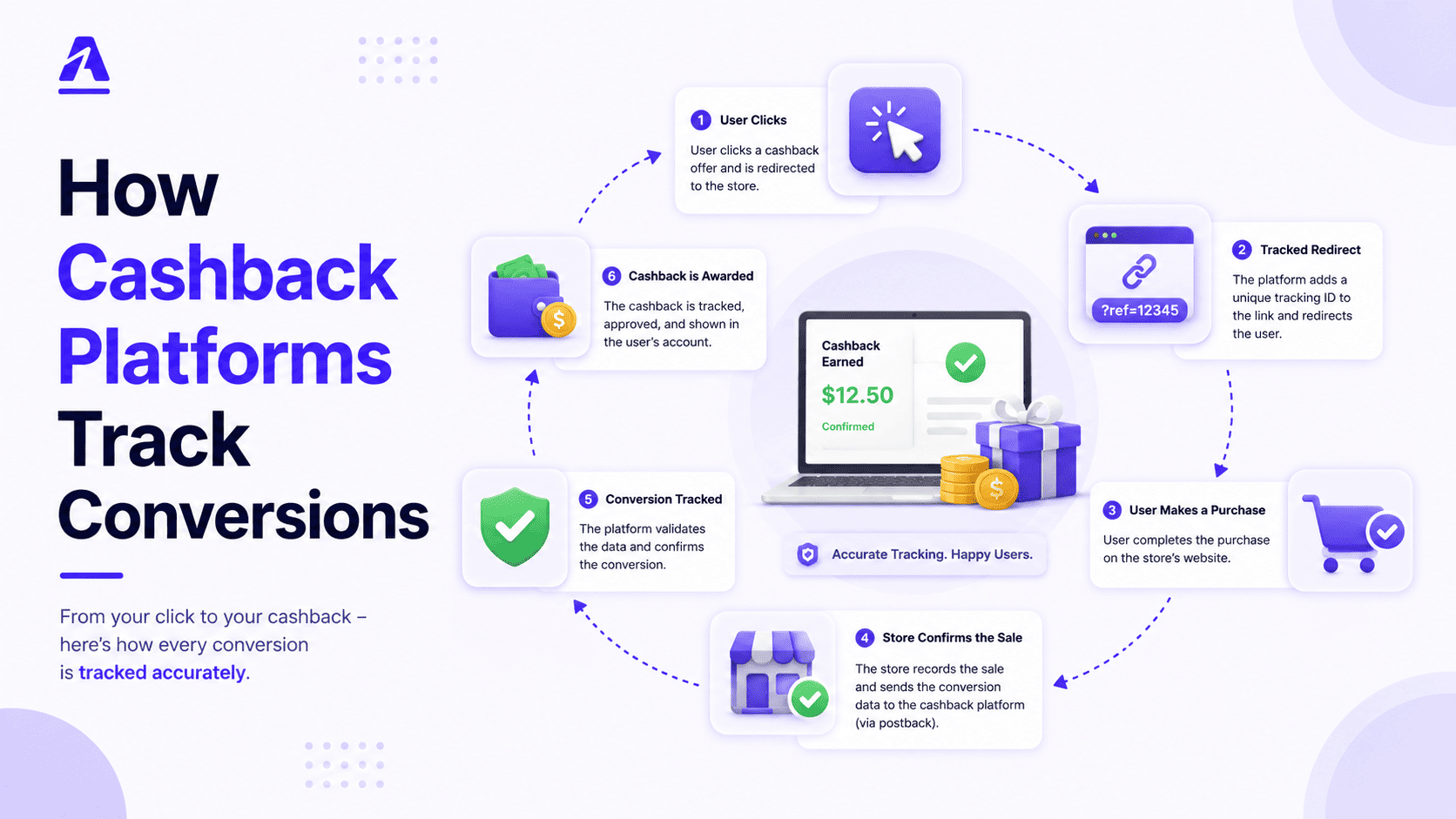
Tracking a user from their initial intent through to the final payout is a multi-step database process. The lifecycle of a cashback conversion follows this detailed timeline:
[1. User Click] ──────> User clicks "Activate 6% Cashback" for Nike Store on Portal
      │
      ▼
[2. Tracker Engine] ──> Tracker generates Click ID ("CL_8871A") and binds it to User ID "USR_449"
      │
      ▼
[3. Redirect Hop] ────> Browser redirects via Affiliate Network tracking URL to Nike Store
      │
      ▼
[4. Cart Checkout] ───> User buys a $150 jacket. Nike store records Click ID "CL_8871A"
      │
      ▼
[5. Network Postback] ─> Nike/Network fires Postback API callback to AffTrax with "CL_8871A"
      │
      ▼
[6. Ledger Update] ───> AffTrax matches "CL_8871A" to User ID "USR_449". Rewards marked "Pending"
      │
      ▼
[7. Validation Window]> 60-day return window passes. Nike confirms sale. Status changes to "Confirmed"
      │
      ▼
[8. Payout Trigger] ──> Cashback balance is unlocked. User requests payout via PayPal/Bank
Step 1: User Clicks a Cashback Link
The journey begins when an authenticated user browses a cashback platform or clicks a browser extension popup (e.g., activating a 6% cashback offer for Nike). The platform does not route the user directly to nike.com. Instead, it directs the browser through an intermediate tracking link hosted on the platform's routing domain.
Step 2: Tracking Parameters Are Recorded
Before forwarding the browser, the tracking engine (such as AffTrax) executes a background routine. It generates a unique, cryptographic transaction token (the Click ID). In the platform's session database, the tracker binds this Click ID to the user's account ID. For example, Click ID CL_8871A is mapped to User ID USR_449. The tracker then appends this Click ID as a query parameter (typically called a Sub-ID, clickref, or custom variable) to the affiliate network's destination URL.
Step 3: User Completes a Purchase
The user's browser performs a quick redirect hop through the affiliate network's server and lands on the merchant's storefront. The merchant's site captures the incoming query parameter containing the Click ID. Modern merchants store this parameter in their backend shopping cart database or secure session state, ensuring that the unique tracking token remains attached to the user's cart session throughout checkout.
Step 4: Conversion Is Reported
As soon as the checkout is completed, the merchant's system records the transaction. The merchant's server (or their affiliate network) immediately notifies the cashback platform's tracking server that a sale occurred. This notification is sent via a server-to-server webhook (a Postback URL) and must include the original Click ID:
https://api.yourcashbacksite.com/postback?subid=CL_8871A&amount=150.00&commission=9.00
Step 5: Commission Is Approved
When the postback webhook hits the tracking server, the system parses the payload. It queries the session database, matches Click ID CL_8871A, and identifies that the purchase belongs to User ID USR_449. The platform updates the database ledger, logging a pending cashback transaction of $5.40 (6% of $150, or a split of the $9.00 commission) to the user's dashboard. At this stage, the status is marked as "Pending" because the merchant's return and cancellation policy is still active.
Step 6: Cashback Is Credited
After the merchant's return window closes (usually 30 to 90 days), the advertiser performs a billing reconciliation. Once the merchant confirms that the purchase was not returned, refunded, or canceled, the affiliate network marks the commission as approved and pays the cashback platform. The platform's automated ledger system then transitions the user's cashback status from "Pending" to "Confirmed," moving the funds into their available withdrawal balance.
Understanding Affiliate Attribution
To understand the mechanics of this journey, we must dissect the protocols powering affiliate attribution. How do servers communicate click and checkout actions without dropping tracking paths?
Understanding Tracking Links
Affiliate tracking links are structured redirects that pass data key-value pairs between platforms. A cashback platform utilizes a tracking system to format outgoing urls dynamically. A typical affiliate destination URL looks like this:
https://network.awin.com/click?publisher_id=8823&merchant_id=4021&clickref=CL_8871A
In this URL:
publisher_id(8823) identifies the cashback website's master account on the network.merchant_id(4021) identifies the specific retail partner (e.g., Nike).clickref(CL_8871A) represents the cashback tracker's dynamic Click ID, which binds the session to the individual user.
Cookie-Based Tracking Explained
In legacy tracking models, attribution relied on browser cookies. When the user clicked the cashback link, a tracking script wrote a first-party or third-party cookie file containing the publisher's ID and tracking parameters to the user's browser storage. When the user reached the checkout confirmation page, a javascript image pixel read the browser cookie and dispatched a confirmation request back to the network.
While simple to implement, cookie-based tracking is highly vulnerable in modern web environments. If the user runs an ad-blocker, browses in incognito mode, or uses a browser that deletes cookies (like Safari), the tracking pixel cannot access the cookie, resulting in an untracked sale.
Server-to-Server Tracking Explained
To ensure tracking reliability, modern platforms utilize Server-to-Server (S2S) tracking. S2S tracking removes the browser from the conversion reporting phase entirely. When the click occurs, the tracking server registers the Click ID and geolocational headers in a secure backend database. The browser is routed to the advertiser's landing page, carrying the Click ID as a URL parameter. Once the conversion occurs, database-to-database API calls handle all transactional validation. This bypasses client-side restrictions completely.
Postback Tracking Explained
Postback tracking is the specific mechanism used to execute S2S callbacks. It relies on a Postback URL, which is a secure API hook hosted by the cashback platform's tracking engine. The advertiser's database executes an HTTP GET or POST request to this URL when a purchase is recorded. Because postbacks run directly between backend servers, they cannot be blocked by browser extensions, script blockers, or privacy settings.
Technical Comparison: Cookie vs. Postback Tracking
| Evaluation Metric | Cookie-Based Tracking | Server-Side Postback Tracking |
|---|---|---|
| Attribution Anchor | Browser storage file (cookie block) | Backend database click records |
| Safari ITP & LTP Impact | Severe (cookies blocked or deleted in 24 hours) | None (server API communication is unaffected) |
| Ad-Blocker Sensitivity | High (blocks tracking scripts and script tags) | Zero (callbacks run backend-to-backend) |
| Reliability for Cashback Ledger | Poor (drops 15-30% of conversions) | Near-perfect (requires database mappings) |
| Setup Overhead | Low (inserting client javascript snippets) | Medium (requires database parameter logging) |
How Affiliate Networks Report Conversions
Affiliate networks (such as CJ Affiliate, Impact.com, Rakuten Advertising, and Awin) serve as the technology clearinghouse between cashback websites and brands. Instead of the cashback platform building thousands of direct API integrations with individual merchants, they connect to these affiliate networks. The network collects conversion data from merchants and reports it to the cashback platform via two main methods:
- Real-Time Webhooks: Immediate server postbacks dispatched to the cashback platform's postback endpoint seconds after checkout occurs. This is the optimal setup for rewards platforms, allowing them to notify users of their pending cashback instantly via push notifications or emails.
- Automated CSV API Pulls: Scheduled daily cron jobs that fetch conversion reports from the network's API. This is used by older platforms or merchants who do not support real-time webhooks, meaning users might wait 24 to 48 hours to see their pending balance update.
How Advertisers Validate Purchases
Merchants do not approve commissions blindly. To protect their margins, they run validation routines to audit traffic quality and sales integrity before payouts are finalized. The validation process checks for:
- Customer Returns & Order Cancellations: If a customer returns a product, the merchant reverses the affiliate commission, which in turn prompts the cashback platform to cancel the user's pending cashback.
- Incorrect Promo Codes: If a user applies an unauthorized coupon code (such as an exclusive influencer code or an employee discount code) at checkout, the merchant may void the affiliate tracking commission or reduce the payout rate.
- Attribution Overwrites (The Coupon Cookie Jump): If a user activates cashback, redirects to the merchant's site, but then opens a secondary coupon site tab to find a promo code, the second site's tracking cookie can overwrite the cashback click. The network attributes the sale to the coupon site, causing the cashback conversion to go missing or be declined.
Advertiser Tracking vs. Affiliate Network Tracking
| Tracking Entity | Primary Tracking Goal | Methodology | Data Verification & Audit Role |
|---|---|---|---|
| Advertiser (Merchant Store) | Verify product checkouts and capture Click IDs. | Shopping cart session tracking, database-level logging. | Audits transactions against refund databases, cancels commissions on returned items, flags duplicate orders. |
| Affiliate Network (Network Clearinghouse) | Distribute commission credit between publishers. | Redirect tracking routing, cookie mapping, API webhooks. | Acts as the trusted ledger, aggregates data from thousands of merchants, tracks cross-site clicks, filters basic click fraud. |
Pending vs. Confirmed Cashback
Every cashback user is familiar with the status transition from pending to confirmed. This delay exists because of the financial reconciliation lifecycle. When a transaction is logged, it immediately enters a pending state to protect the platform from payout deficits.
Pending vs. Confirmed Cashback
| Characteristic | Pending Cashback | Confirmed Cashback |
|---|---|---|
| Status Definition | Purchase recorded but advertiser validation is in progress. | Commission approved and paid by the merchant. |
| Withdrawal Eligibility | Locked (cannot be cashed out) | Unlocked (available for payout) |
| Reversal Risk | High (subject to returns, cancellations, and edits) | None (transaction is legally settled) |
| Typical Duration | 30 to 90 days (matching return windows) | Permanent until withdrawn |
Why Cashback Tracking Sometimes Fails
Even with advanced tracking networks, the digital advertising ecosystem is complex, and tracking failures can happen. For cashback operators, understanding why these failures occur is the first step toward building a highly accurate network.
Most Common Tracking Issues
A cashback tracking pathway can break at several points:
- Cookie Cleansers & Adblockers: Browser extensions (like uBlock Origin or AdBlock Plus) actively block tracking domain calls. If the affiliate network relies on client-side redirect domains, the blocker intercepts the redirect, and the transaction is never recorded.
- Session Hijacking: If a user utilizes a browser extension that auto-applies coupons (e.g., Honey or Capital One Shopping), the extension can execute its own affiliate link click at the last second. This overwrites the user's initial click from the cashback portal, shifting the commission to the coupon extension.
- Cart Abandonment & Re-entry: If a user activates cashback on their mobile app, adds an item to their cart, but closes the app and completes the purchase on their laptop via a direct browser tab, the tracking sequence breaks. The click session was bound to the mobile device and is not inherited by the laptop checkout unless the merchant uses advanced cross-device tracking.
Cross-Device Tracking Challenges
Tracking users across multiple devices (e.g., clicking an ad on a smartphone but purchasing on a desktop computer) is a major hurdle in performance marketing. In a privacy-first web, platforms cannot rely on cross-site tracking cookies. To address this, modern networks utilize **Deterministic Attribution**, matching user logins across mobile apps and desktop portals. If the user is logged into the cashback platform on both devices, the tracker maps the click ID to the unified user account in the cloud database, enabling cross-device resolution.
Cookie Restrictions and Privacy Changes
Privacy frameworks, such as Apple's Intelligent Tracking Prevention (ITP) and Link Tracking Protection (LTP), place strict limits on attribution data. Safari actively strips query parameters associated with tracking from URLs (like Awin's clickref or Google's gclid) during private browsing. Concurrently, first-party cookie lifespans are capped at 1 to 7 days if set via client-side JavaScript. This means any purchase occurring after a week is lost to the system if client-side tracking is the only method used.
How Modern Cashback Platforms Improve Accuracy
To overcome browser restrictions, high-performance cashback platforms employ these advanced strategies:
- CNAME DNS Mapping: By setting up a CNAME record in their DNS configuration, platforms map their tracking links to their first-party domain (e.g., routing traffic through
rewards.yourdomain.cominstead of a third-party domain). This ensures all cookies and scripts run within a first-party namespace, bypassing standard ad-blockers and privacy filters. - Server-to-Server Postback Integrations: Transitioning entirely to server-side postbacks. The platform's tracking backend generates a unique cryptographic transaction Click ID, passes it via API to the advertiser, and receives direct server updates upon checkout, bypassing the browser entirely.
- Edge-First Routing Engines: Implementing compiled, high-speed redirect routing (such as Go or Rust edge nodes) to resolve redirect hops in under 15 milliseconds. This eliminates latency-induced drop-offs, ensuring that users land on the merchant store without noticing the redirect.
How Fraud Impacts Cashback Platforms
Because cashback websites deal with direct financial payouts, they are major targets for affiliate fraud. Standard fraud tactics include:
- Self-Referral & Multi-Accounting: Users opening dozens of accounts using VPNs and virtual credit cards to claim sign-up bonuses and exploit flat-rate cashback offers.
- Cookie Stuffing: Fraudulent publishers using hidden frames to execute click scripts in a user's browser behind the scenes, overwriting organic conversions and claiming unearned commissions.
- Transaction Spoofing & Refund Exploits: Purchase abusers buying expensive items to trigger high cashback credits, and then returning the items after requesting fast cashback payouts, exploiting platforms with short pending windows.
Modern platforms combat this by integrating Partner Management Software features that include edge proxy detection, browser canvas fingerprinting, and strict 60-day payout holding periods to verify that returns are not filed before releasing funds.
Best Practices for Cashback Tracking
To build a secure, accurate, and profitable rewards brand, operators should implement these best practices:
- Implement Cookieless S2S Postbacks: Insist that your advertiser partners and affiliate networks support server-side postbacks to ensure data integrity.
- Verify Webhook Callbacks: Protect your API endpoint by enforcing cryptographic signature validation on incoming postbacks, preventing attackers from injecting fake conversion records into your database.
- Use White-Label CNAME Domains: Route all campaign links through your own DNS subdomain to preserve first-party cookie status and bypass script-blockers.
- Establish a Payout Buffer Queue: Implement a robust holding queue (Net-60 or Net-90) to match advertiser validation timelines and mitigate chargeback liabilities.
Future of Cashback Tracking
The future of cashback tracking lies in direct integration with open banking APIs and card-linked offer (CLO) networks. Instead of relying on tracking links and browser extensions, card-linked rewards enable users to link their credit or debit card to the cashback app. When they swipe their card at a participating merchant, the transaction is reported directly by the payment processor (Visa, Mastercard, or Plaid) to the cashback platform. This provides a seamless customer experience, bypasses browser privacy controls, and bridges the gap between online and offline shopping.
Frequently Asked Questions
1. How do cashback websites make money?
Cashback websites earn commissions from merchants for referring sales through affiliate tracking networks. They split this commission with the shopper, keeping a portion (the margin) as revenue.
2. Why does my cashback status show as "Pending"?
A "Pending" status means your purchase was tracked, but the advertiser's validation window is active. The cashback remains pending until the merchant confirms the order was not returned or canceled.
3. What is a Click ID in cashback tracking?
A Click ID is a unique, database-backed alphanumeric token generated when a user clicks a cashback offer. It binds the click session to the user's account and is used to match conversions.
4. Can ad-blockers stop cashback from tracking?
Yes. Ad-blockers can block client-side affiliate redirect scripts and tracking pixels, preventing conversions from being recorded. Using server-to-server postbacks and CNAME routing mitigates this issue.
5. How does server-to-server postback tracking work?
S2S postback tracking passes a unique Click ID from the cashback platform to the advertiser. When checkout is completed, the advertiser's server calls the cashback platform's API to report the sale, bypassing the browser entirely.
6. What is a conversion reversal?
A conversion reversal occurs when an advertiser voids a previously logged affiliate commission, usually because the customer returned the product, canceled the order, or used an unauthorized promo code.
7. Why did my cashback transaction go missing?
Missing cashback usually occurs when browser cookies are blocked, another coupon extension overwrote the tracking link at checkout, or the user closed the window and completed the purchase in a new session.
8. How long does it take for cashback to be confirmed?
It typically takes 30 to 90 days for cashback to transition from pending to confirmed, matching the merchant's return and credit card chargeback window.
9. What is Apple's ITP and how does it affect tracking?
Apple's Intelligent Tracking Prevention (ITP) blocks third-party cookies and caps first-party cookies set via JavaScript to 1-7 days in Safari, making traditional cookie-based affiliate pixels unreliable.
10. Can I get cashback if I use a coupon code?
Only if the coupon code is officially approved by the cashback platform. Using external codes (from influencer pages or other coupon sites) can overwrite the tracking cookie, voiding the cashback commission.
11. How do card-linked cashback offers work?
Card-linked offers connect a user's credit or debit card directly to the cashback system. When the card is swiped at a participating retail store, the payment processor reports the sale directly to the platform, eliminating redirect links.
12. What is a Sub-ID?
A Sub-ID is a custom tracking parameter appended to affiliate links (like sub1 or clickref). Cashback platforms use it to pass their unique Click ID and route commissions to the correct user account.
13. What happens if I return an item?
If you return a purchase, the merchant cancels the affiliate commission. The cashback platform detects this reversal and removes the corresponding pending credit from your ledger.
14. How do cashback platforms prevent referral fraud?
Platforms detect fraud using device fingerprinting, proxy detection to block VPN subnets, limit checks on sign-up activity, and hold commissions in pending queues to review transaction validity.
15. What is the role of an affiliate network in cashback tracking?
Affiliate networks aggregate campaigns from thousands of merchants, track click redirects, manage billing ledger updates, and provide unified reporting APIs for cashback platforms.
Conclusion
Conversion tracking is the operational backbone of the cashback industry. While legacy client-side cookies are crumbling under modern browser privacy controls, transition to cookieless server-to-server postback tracking and DNS CNAME mapping ensures that rewards portals maintain 100% attribution accuracy. By utilizing an advanced White Label Affiliate Software platform like AffTrax, cashback operators and loyalty programs can run edge-first redirect routing, secure their callback webhooks, and automate rewards ledgers with confidence. To protect your margins and future-proof your loyalty brand, launch your platform on Incentive Marketing Platform architecture today.